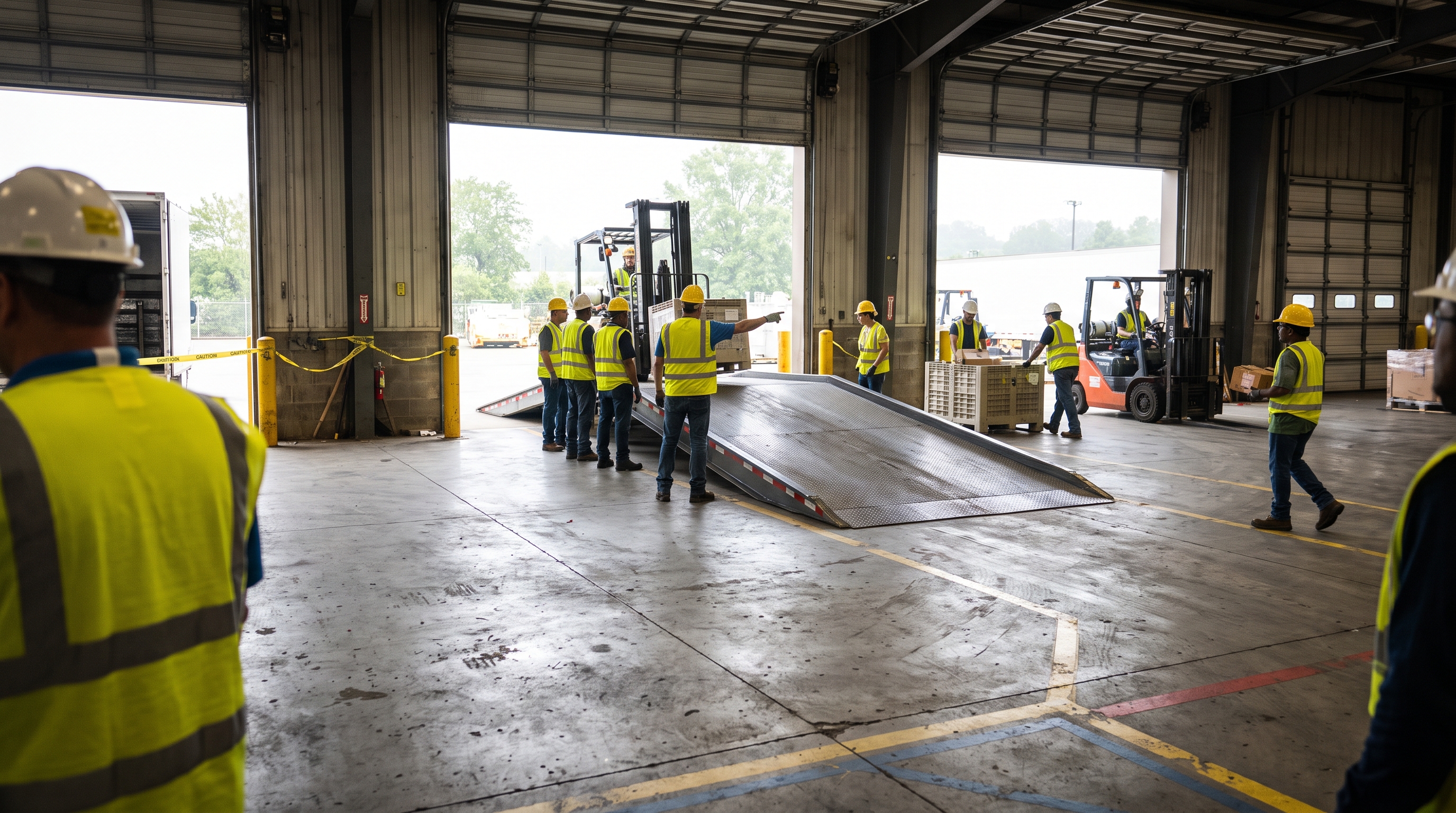
Ramps and grades are where forklift operations most often go wrong, because an incline changes the forces that keep a truck stable. On flat ground, the center of gravity sits comfortably inside the wheelbase; on a grade, that center shifts, the effective load capacity drops, and the truck’s behavior under braking changes completely. OSHA 29 CFR 1910.178(n) addresses truck operations on grades directly, and the rules are simple enough to memorize but easy to violate under pressure. This guide covers the grade-related rules for forklift operation, how load position changes uphill and downhill travel, and the facility practices that keep ramps and dock inclines safe, with reference to OSHA 1910.178(n) and ANSI/ITSDF B56.1.
The OSHA Grade Rules
OSHA 29 CFR 1910.178(n) is short and unambiguous about grades. The rule states that grades shall be ascended or descended slowly, that when ascending or descending grades in excess of 10 percent, loaded trucks shall be driven with the load upgrade, and that on all grades the load and elevating mechanism shall be tilted back as far as possible and raised only as far as necessary to clear the road surface. These three requirements, slow speed, load upgrade above a 10 percent grade, and tilted-back lowered load, are the core of ramp safety and apply to counterbalance trucks. The rationale is stability: keeping the load on the uphill side and the mast tilted back positions the combined center of gravity to resist tipping backward or forward as the truck climbs or descends.
Load Position: Uphill and Downhill
The load upgrade rule is the one most frequently misunderstood, so it is worth being precise. When a loaded truck travels up a grade, the forks point uphill and the load sits on the uphill side of the truck. When traveling down a grade, the load is still kept upgrade, which means the truck drives in reverse, with the forks pointing back uphill toward the top of the ramp. Driving a loaded truck down a ramp face-first tilts the load’s weight forward and toward the downgrade side, which shifts the center of gravity dangerously toward the front axle and reduces rear-axle steering control. The exception is unloaded trucks, which OSHA says should be driven with the forks downgrade, because with no load the counterweight becomes the heavier element and the grade rule reverses. Operators should internalize this as a pair of habits: loaded means forks uphill, unloaded means forks downhill.
Braking and Speed on Grades
Grades punish abrupt inputs. Braking hard on a downslope can shift the load forward or cause the truck to slide, especially on wet or oily dock surfaces, and turning on a grade with a raised load dramatically narrows the stability margin. OSHA’s requirement to ascend and descend slowly is backed by the physics: a forklift is not a car, and its braking is designed for a much lower speed regime. Operators should use engine braking where available, brake smoothly and early, and never attempt to turn on a ramp if the turn can be completed on level ground instead. Loads should be carried as low as possible while still clearing the ramp surface, and the mast tilted back fully, because a raised load on a grade converts a small bump into a large tip-over risk. The general principles of forklift tipping apply even more sharply on inclines.
Ramp Design and Facility Practice
The facility side of ramp safety is about design and maintenance. Ramp grades should be as gentle as the layout allows, and the transition areas at the top and bottom should be smooth, because the change in angle at a transition is itself a shock to the truck’s stability. Ramp surfaces need good traction, which means regular cleaning of oil, dust, and debris, and drainage that keeps water from pooling. Where pedestrian and truck paths cross a ramp, the interaction should be managed explicitly, because a pedestrian on a ramp is in the path of a truck that cannot stop quickly and cannot maneuver. Keep pedestrians off truck ramps entirely where possible, and use walkways and warehouse pedestrian safety measures where they cannot be separated.
Dock Ramps and Levelers
Dock approach ramps and levelers are a special category, because they combine grade with the edge-of-dock hazard. A truck crossing a leveler is on a short, steep transition with the dock edge below, and a misstep or a shifted load can put the truck at the edge. Operators should verify the leveler is positioned and locked before crossing, check that the trailer is secured against creeping, and approach the edge at controlled speed with the load low. The dock area is one of the highest-risk zones in any facility, and the interaction between trucks, trailers, and pedestrians there deserves its own review; our loading dock forklift safety guide covers the specifics.
Training and Verification
Ramp rules are best learned as muscle memory, which means training on actual ramps, not just in a classroom. Operators should practice loaded and unloaded ramp runs, with a spotter in training, until the forks-uphill and forks-downhill habits are automatic. Supervisors should verify the habit in the field, because a driver who breaks the rule only on the last trailer of the day is exactly the driver who will be caught out by a wet ramp and a heavy load. Ramp conditions should also be part of the regular walk-around, with traction, transitions, and signage checked in the same rhythm as the truck itself.
Ramp safety is a small set of rules with an outsized consequence if ignored. Slow down, keep the load upgrade, tilt the mast back, and treat every grade transition as a controlled event. To see where your facility’s ramps and overall forklift risk sit, run the forklift risk assessment tool. For a complete look at the controls that protect trucks, operators, and pedestrians, review the forklift safety systems index or request a quote.

